• Skip to main content
Hiking 101 Class in Bella Vista · Sat, Oct 17 · 8–10 AM · Free · Get your ticket →Hiking 101 Class in Bella Vista · Oct 17 · Free · Tickets →

Hike NWA

How to start hiking in Northwest Arkansas.

  • Home
  • Explore
    • Bella Vista
    • Bentonville
    • Trail Systems
    • Trail Map
    • Trail List
    • Trailheads
    • Trail Difficulty
    • Trail Surfaces
  • Plan
    • Getting Started
    • Route Library
    • Hikeable Trails
    • Beginner Hikes
    • FAQs
  • Guides
    • Before You Hike
    • Clothing & Gear
    • Staying Safe
    • On the Trail
  • About
    • Our Team
    • Contact
  • Get Involved
    • Join a Group Hike
    • Lead a Hike
    • Donate
  • Find Routes
Home/Hiking Guides/Clothing & Gear/Choosing Hiking Shoes and Socks

Choosing Hiking Shoes and Socks

The best hiking shoe is the one that fits your foot, not the one with the most features. Walk into an outdoor store and you’ll find trail runners, hiking shoes, and hiking boots, each promising something different. The good news is that the choice is simpler than it looks. This guide explains the three types, what actually matters when you try them on, whether you need waterproofing, and why your socks count as much as your shoes.

On this pageThree Types of ShoesHow They CompareHow They FeelHow They FitWaterproof or Not?Socks Really MatterWhere to Next?More Guides
Two brown leather hiking boots on white rocks, with a thick wool sock tucked into one

Three Types of Shoes

Hiking footwear comes in three main styles. Trail runners look like sturdy running shoes. Hiking shoes are low-cut like a sneaker but built heavier. Hiking boots rise above the ankle and have the stiffest soles.

A hiker wearing low, lightweight trail runners on gravel
TRAIL RUNNERS
A hiker wearing brown low-cut hiking shoes on a rocky trail
HIKING SHOES
A hiker wearing mid-height hiking boots and wool socks on gravel
HIKING BOOTS

Here’s what surprises most people. The tread is essentially the same on all three. The lugs on the bottom that grip rocks, roots, and loose gravel are just as good on a trail runner as on a heavy boot. You don’t need boots to get good grip, so the choice comes down to weight, stiffness, and how the shoe feels on your foot.

How They Compare

Trail RunnersHiking ShoesHiking Boots
WeightLightMediumHeavy
Sole StiffnessFlexibleSupportiveStiff
Break-In TimeNoneLightExtensive
LifespanWears out firstLasts longerLasts longest

Trail runners feel good right out of the box and weigh the least, but they wear out sooner. Boots take time to break in and weigh the most, but they last the longest and give the stiffest platform underfoot. Hiking shoes sit in the middle on every count.

None of these is the right answer for everyone. Use the table to narrow your choices, and then let the next two sections make the decision.

How They Feel

A hiker walking uphill on a leaf-covered dirt trail in lightweight trail shoes
Lighter shoes feel better the longer you walk.

What matters most is how the shoes feel and how they fit. Start with feel.

  • Trust the store test. If a shoe isn’t comfortable in the store, it won’t be comfortable on the trail. Don’t count on a shoe getting better with wear.
  • Look for zero hot spots. You should feel no pinching, rubbing, or pressure anywhere. A small annoyance in the store becomes a blister a few miles in.
  • Pick the cushioning you like. Cushioning is personal. More isn’t better—it’s just softer. Some people love a thick, plush sole, and others prefer to feel the ground.
  • Favor lighter shoes. Lighter feels better the longer you walk. A few extra ounces on each foot adds up over thousands of steps.
  • Remember the socks. Your socks are part of the shoe, so wear the socks you plan to hike in when you try on shoes. The same shoe can feel completely different with a thin sock and a thick one.

How They Fit
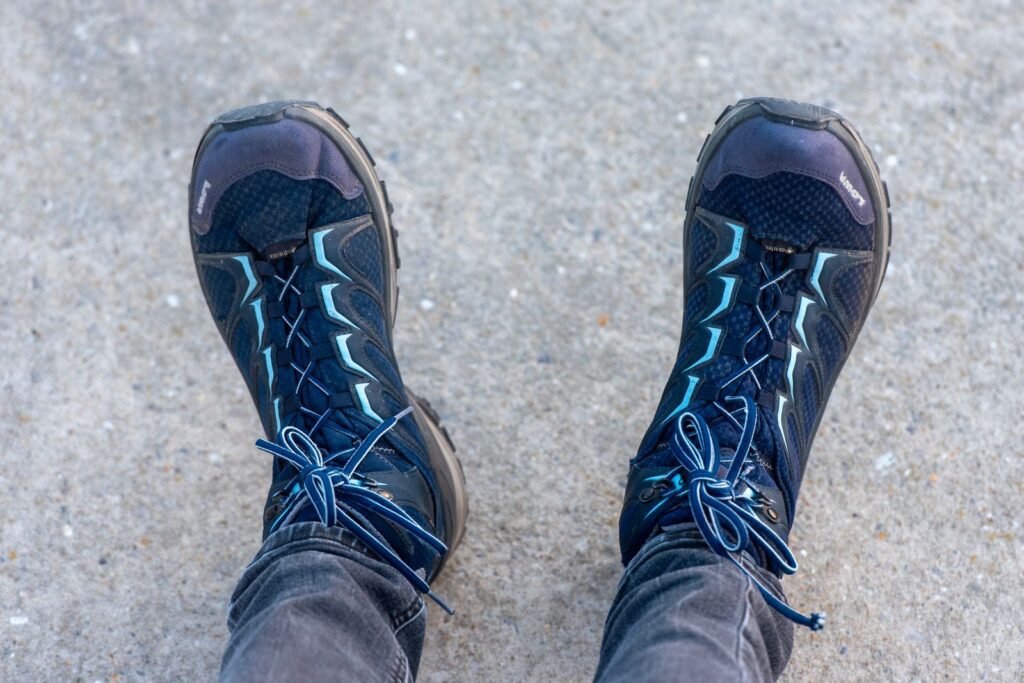
Looking straight down at a pair of blue hiking boots on pavement
Leave about a thumb’s width between your longest toe and the end of the shoe.

Hiking shoes usually fit differently from your everyday shoes. Check each of these before you buy.

  • Leave room in front. You want about a thumb’s width between your longest toe and the end of the shoe. That usually means going a half size to a full size larger than your normal shoe.
  • Give your toes space. The shoe should be wide enough that your toes can spread out when you stand.
  • Keep your heel down. Your heel shouldn’t lift when you walk. A heel that slides up and down rubs a blister fast.
  • Test it downhill. Walk down a slope or a ramp in the store. Your toes shouldn’t hit the front of the shoe. If they do, your toenails will pay for it on every descent.

Feet swell over the course of the day and on longer walks, so it helps to shop in the afternoon or evening.

Waterproof or Not?

Water pouring onto a black waterproof trail shoe resting on a log in the woods
Waterproofing keeps water out, but it keeps sweat in too.

Many hiking shoes come in a waterproof version, usually for a higher price. Whether it’s worth it depends on when and where you hike.

  • It works both ways. A waterproof shoe is great at keeping water out and just as good at keeping it in. Sweat has a harder time escaping, and if water comes in over the top, it stays there.
  • The label isn’t the whole story. Gore-Tex® is a brand name, not necessarily better waterproofing. Other waterproof linings can work just as well.
  • It shines in cold and wet weather. Waterproof shoes are great for winter and for hiking after rain, when dry, warm feet matter most.

In hot, humid weather, a breathable mesh shoe often feels better, because it lets your feet cool off and dries quickly if it gets wet. Some hikers own one of each. If you hike mostly in cold weather, our winter hiking guide covers traction and other cold-weather footwear.

Socks Really Matter

A hiker sitting on rocky ground in shorts, wearing green wool hiking socks
Merino wool or synthetic socks, tall enough to clear the top of the shoe.

Friction and moisture cause blisters. Good socks keep your feet drier and cut down the rubbing, which is why they’re worth as much thought as the shoes.

  • Choose wool or synthetic. Merino wool and polyester or nylon blends pull sweat away from your skin. Never hike in cotton socks, which hold moisture against your feet.
  • Go taller than the shoe. The sock needs to clear the top of the shoe. If the collar of your shoe touches bare skin, it will rub and may cause a blister.
  • Try on shoes while wearing your hiking socks. Cushioning in socks is personal too, and a thin sock and a thick one can change how the same shoe fits.
  • Try toe socks for stubborn blisters. If you still get blisters between or on your toes, toe socks might be a great solution. Each toe gets its own sleeve, so toes can’t rub against each other.

For the rest of your hiking outfit, read What to Wear Hiking in Northwest Arkansas.

Where to Next?

Trail SurfacesSee the ground your shoes will be walking on. Beginner HikesBreak in new shoes on a short, easy route. Route LibraryGo find a hike.

This guide is general information from a volunteer trail organization, not medical advice. In an emergency, call 911. See our Terms of Use and Trail Safety Disclaimer.

Read the Previous GuideWhat to Wear Hiking in Northwest ArkansasClothing & Gear · 1 of 4 guidesRead the Next GuideDay Hike Gear ChecklistClothing & Gear · 3 of 4 guides

More “Clothing & Gear” Guides

What to Wear Hiking in Northwest ArkansasRead the guide Day Hike Gear ChecklistRead the guide Water, Electrolytes, and Trail SnacksRead the guide

More Guide Categories

Before You HikeWhich trails you can hike, getting your body ready, and finding people to hike with.Staying SafeWeather, ticks, snakes, cold, and what to do if something goes wrong.On the TrailHow to share the trail, take care of it, and bring your dog along.

All Hiking Guides →

Explore & Plan a Hike

  • Bella Vista
  • Bentonville
  • Trail Systems
  • Trail Map
  • Trail List
  • Trailheads
  • Trail Difficulty
  • Trail Surfaces
  • Route Library
  • FAQs

Guides & Resources

  • Getting Started
  • Hiking Guides
  • Before You Hike
  • Clothing & Gear
  • Staying Safe
  • On the Trail
  • Beginner Hikes
  • How to Use Komoot
  • Bella Vista Walks & Hikes
  • Read the Community Fundamentals
  • Sign the Waiver

Hike NWA

  • About
  • Donate
  • Contact
  • Privacy Policy
  • Terms of Use
  • Donation Policy
  • Accessibility
  • Hike Lead Dashboard
  • Facebook
  • Instagram
  • Strava
  • Komoot

Copyright © 2026 · Hike NWA · A registered 501(c)(3) nonprofit organization
Mailing address: 412 Town Center NE #1044, Bella Vista, AR 72714 · EIN: 42-2911997

Powered by
Necessary cookies enable essential site features like secure log-ins and consent preference adjustments. They do not store personal data.
None
Functional cookies support features like content sharing on social media, collecting feedback, and enabling third-party tools.
None
Analytical cookies track visitor interactions, providing insights on metrics like visitor count, bounce rate, and traffic sources.
None
Advertisement cookies deliver personalized ads based on your previous visits and analyze the effectiveness of ad campaigns.
None
Unclassified cookies are cookies that we are in the process of classifying, together with the providers of individual cookies.
None
Powered by