
Trail Surfaces: What You’ll Be Walking On
Every route on this site carries a difficulty badge—Paved, Easy, Moderate, or Challenging. Those badges tell you how difficult the route is. They do not tell you what it feels like underfoot, and for a lot of new hikers that is the more useful question. This page answers it with photographs of the actual surfaces you will meet on Bella Vista and Bentonville trails.
“Natural surface” doesn’t mean soft · Packed dirt · Gravel · Leaf litter · Pine needles and duff · Loose rock · Rocky, eroded tread · Solid rock · Roots · Water crossings · Bridges & wood features
“Natural surface” doesn’t mean soft
You’ll see the phrase natural surface all over this site. It has a specific meaning, and it’s worth clarifying to avoid any confusion.
Paved is our only hard surface. That means the trail is asphalt or concrete, six feet or wider, with no rocks and no roots. Paved-surface trails are greenways and park paths, and strollers and wheelchairs do well on it (with some exceptions).
Everything else is natural surface, which simply means the trail is made of whatever the ground is made of—dirt, gravel, rock, and roots. Sometimes natural-surface trails are called “soft-surface trails,” but that is misleading. Soft-surface, natural trails do not necessarily have soft, cushioned, or gentle surfaces. On the contrary, plenty of natural-surface trail around here is solid rock, and likely the vast majority is loose or embedded rock over packed dirt that definitely doesn’t feel like you’re walking on a soft surface.
The rest of this page gives you an introduction to the variety of natural surface trails you can hike on in Bella Vista and Bentonville.
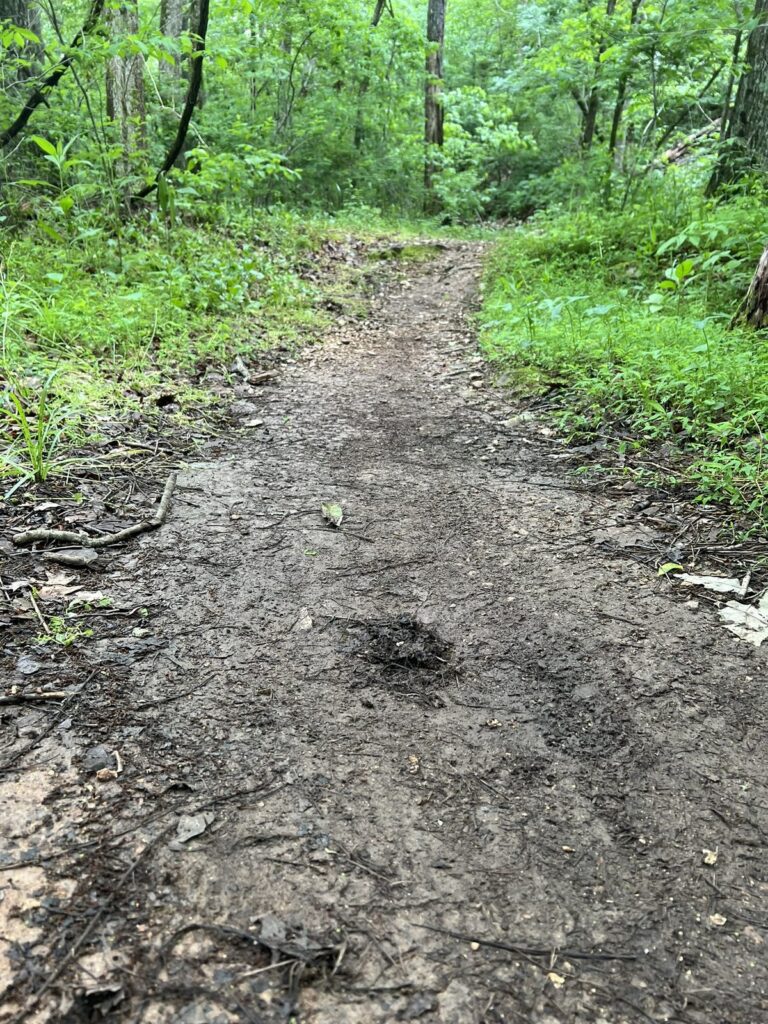
Packed dirt
Packed dirt is what you get when thousands of footsteps cross a dirt path. Many of the trails marked as Easy are packed dirt, as are many of the sidepaths that run along the edges of roadways.
Freshly built or recently rebuilt trail has not been packed fully yet, so it may be a little loose or crumbly until traffic and rain settle it. Packed dirt trails are also very likely to turn into mud when there is heavy rain, especially in areas that are sunken and retain water. Avoiding trails after rain if your footstep leaves an impression in the soft or wet dirt is best practice to prevent damage to the trails.


Gravel
Gravel is the workhorse surface—crushed stone spread over the tread to keep it firm and draining. Around here that stone is usually local limestone or chert, because that is what the ground is made of. It is generally stable, even, and pleasant to walk on.
The variety matters. Fine crushed stone with broken faces packs down almost like pavement, which is why trail builders prefer it to smooth rounded gravel. Coarser gravel with cobbles set into it stays firm underfoot but catches toes—especially when you’re on that last mile of your hike.


Leaf litter
For several months beginning in autumn and through much of the winter, the trail simply disappears. Fallen leaves accumulate across the trail surface until the edges are guesswork and whatever is underneath—a rock, a root, a hole where a rock used to be—is completely hidden. After a rain, the leaves can be especially slick.


Pine needles and duff
Anywhere pines stand overhead, the trail surface collects a layer of fallen needles, twigs, and dead vegetation. It is the closest thing we have to a genuinely soft surface, and it’s usually a pleasure to hike on.


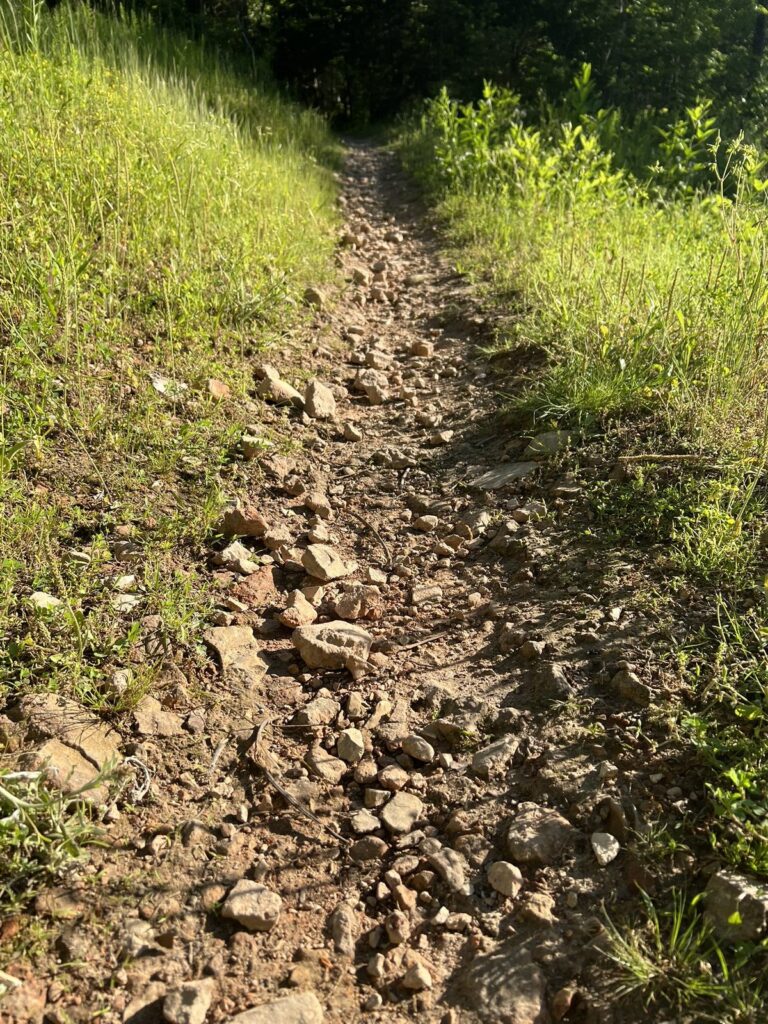
Loose rock
This is the type of tread that often challenges people. Larger loose rock sits on the trail rather than in it. Walking on this type of surface can be hard on ankles and if you’re wearing thin-soled shoes, you will feel every single rock.


Rocky, eroded tread
Water is the sculptor of practically every Ozark trail. Rain runs downhill along the path of least resistance—which is usually the trail—and carries the fine dirt away, leaving the rock behind. The result is tread that began as dirt and has slowly become a rocky channel.
You will meet this most often on climbs, which is exactly where you would rather have good footing. This type of tread is completely normal here, and it is the main reason a Moderate route can feel harder than its distance suggests.



Solid rock
Sometimes the erosion goes all the way down and the trail simply becomes the bedrock itself. Trail builders may even set big embedded rocks deliberately. Larger sections of rock like this are often called rock gardens.
The good news is that solid rock is the most reliable footing on a trail because it (usually) does not move. The bad news is that it can be slick when wet, so give a wet rock slab the same respect you would give ice and take it slowly.


Roots
Trees on a thin-soiled hillside send their roots sideways, and the trail cuts across them. Roots are a very common trip hazard on our trails and the most consistently underestimated. They sit low, they are often the same color as the ground, and they are extremely slippery when wet.


Water crossings
Creeks cut through many of our trail systems here, and not all of those crossings have a bridge. Some crossings are a line of stepping stones, some are a shallow run of water straight across the tread, and some are dry for most of the year and only appear after rain.
If your route includes a water crossing, waterproof shoes are a good idea, especially if it has rained recently. Rock sitting in moving water is slicker than the same rock out of it, so test each step before you put your weight on it. Water that is higher, faster, or muddier than usual is a good reason to turn around, and some creeks can come up quickly during and after heavy rain.


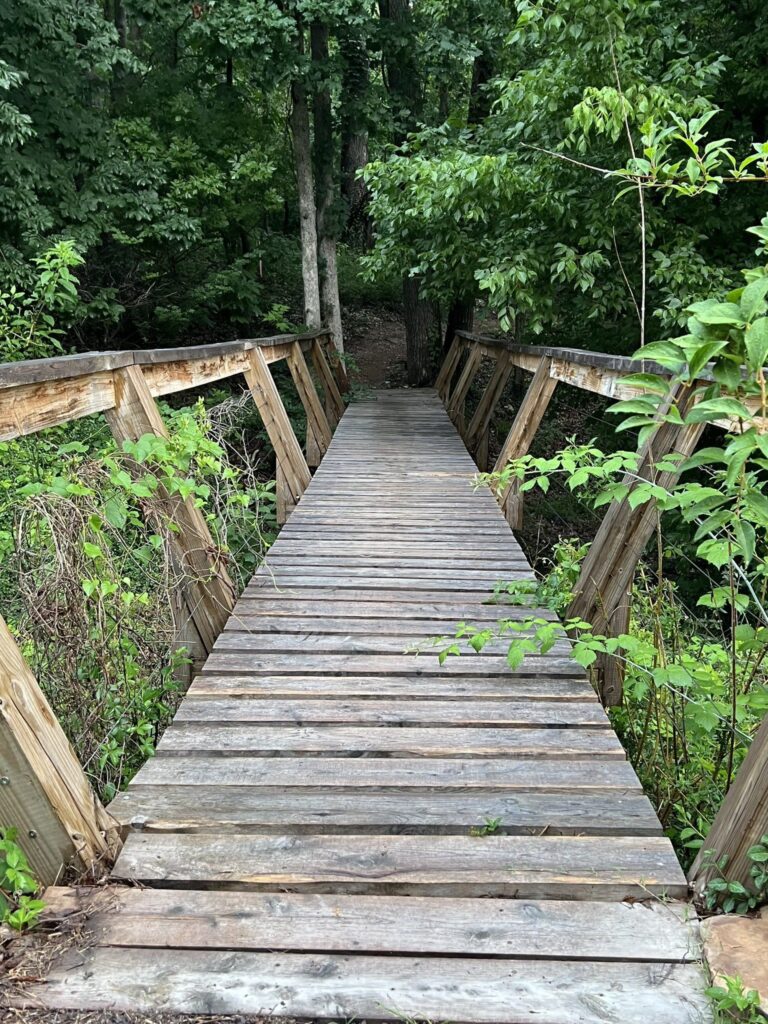
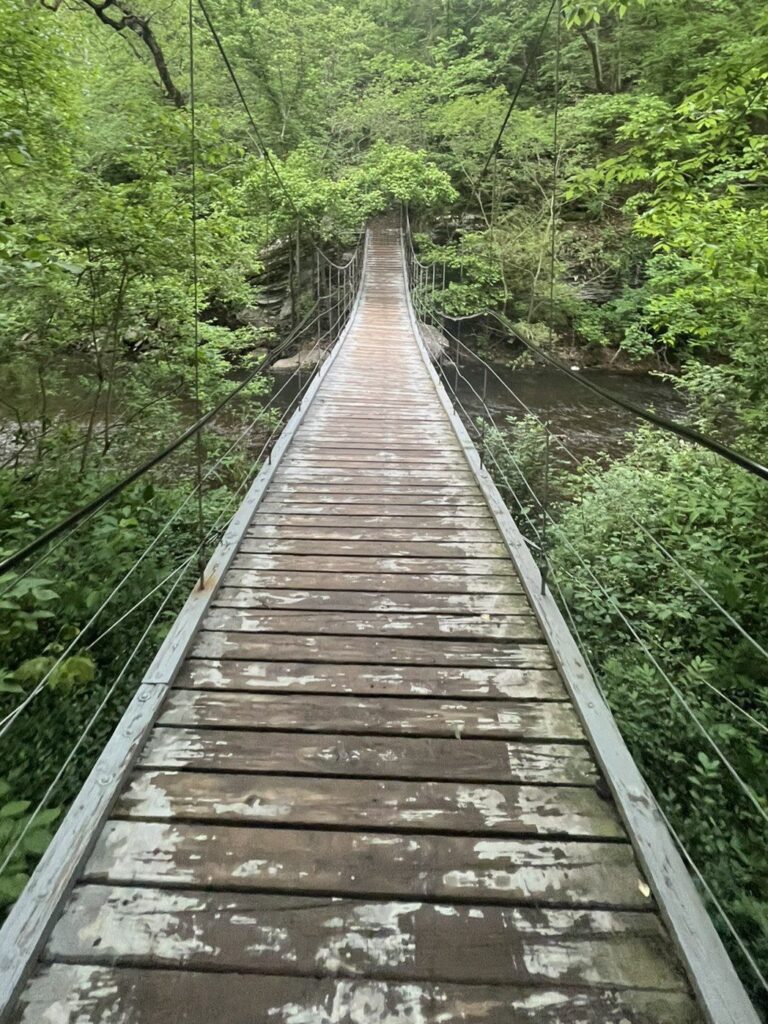
Bridges & wood features
Northwest Arkansas is cut through with creeks and steep hollows, so a good deal of our trail mileage crosses something. Our bridges run from a few planks laid over a wet spot to steel spans above open water, and the variety is worth knowing before you meet it.
One thing is true of all of them. Wood decking gets slippery when wet, frosty, or covered in wet leaves, in a way that plain dirt does not. It even gets slippery when it’s just extremely humid, so be cautious when crossing them in wet, frosty, or humid conditions.





Ready to pick a trail?
Now that you know what is underfoot, go find some trails to hike!
- Know what you’re looking for? Find a Hiking Route lets you filter by difficulty and distance.
- New to hiking here? Getting Started on NWA Trails covers what to bring and how to share the trail.
- Want to build up gradually? The Beginner’s Guide to Hiking Northwest Arkansas takes you from paved paths to the toughest trails, one short hike a week.
- Need to know where to park? Trailheads and where to park to hike has parking details and directions for every trailhead we cover.
- Not sure what the difficulty badges mean? Trail Difficulty Examples shows what Paved, Easy, Moderate, and Challenging each look like, with photos and video.
Welcome to the trails. Hike more. Live more.