Hike NWA Community Fundamentals
Hike NWA organizes free group hikes across Northwest Arkansas, run entirely by volunteers. Everyone who joins an organized hike signs the Hike NWA Waiver & Release of Liability before their first hike. You sign it once, and it covers every hike you join after that.
When you sign the waiver, you will be asked to acknowledge that you have read and understand the Hike NWA Community Fundamentals in full. That is why this page exists—it tells you everything you need to know to get started hiking with Hike NWA. It sets out who can hike, how hikes are rated and posted, what to bring, and how the group behaves on trails shared with mountain bikers. Please read it from beginning to end before you sign the waiver.
If you’d like to keep track of your progress as you read, tick each section as you finish it. Ticked sections collapse so you can see how far you have to go, and this page remembers your place on this device.
The short version
Nine things matter more than the rest. They are collected here so they are easy to come back to, but this is a summary and not a substitute for the full text below.
- Sign the waiver before you hike.One signature covers every hike you do afterward. Read more →
- Bringing someone under 18 to hike?A parent or guardian must complete one Minor Participation Agreement covering all of their children, and children 13 and under can come only on hikes we have marked family-friendly. Read more →
- Mark yourself GOING on the hiking event.MAYBE counts as not going, and the group may leave once everyone who RSVP’d has arrived. Read more →
- Arrive 10 to 15 minutes early.Time to sort your gear, find the restroom, and meet the group. Read more →
- Leave the dog at home.We love dogs, but they cannot come on Hike NWA hikes. A lot of the dogs on these trails are off leash, and bikes come through fast. Read more →
- Learn these two calls.RIDER UP is a bike coming toward the group, RIDER BACK one coming from behind. Step off to the same side as the person ahead of you. Read more →
- Read a hike’s pace, difficulty, and distance together.A 3-mile Scenic Stroll on a Challenging route is still a hard hike. Read more →
- We hike as a no-drop group.Our aim is that nobody is left behind. If you turn back, tell the hike lead first and text when you reach the trailhead. Read more →
- Bring water (more than you think) and wear insect repellent.Bring more than you expect to need, and check yourself for ticks after every hike. Read more →
About Hike NWA
Hike NWA was established in 2026 for people who want to discover the trails of Northwest Arkansas, either on their own or with a group. We are an Arkansas nonprofit corporation, run entirely by volunteers. There are no dues and no membership fees. Hiking with us is free.
Our group hikes run year-round on everything from paved greenways to natural trails in Bella Vista and Bentonville. We also hold occasional socials, with hikers bringing food to share at the trailhead or heading to a restaurant after the hike.
Hike NWA and Bella Vista Walks & Hikes
If you found us through Bella Vista Walks & Hikes and the name “Hike NWA” is new to you, here is how the two fit together.
Bella Vista Walks & Hikes came first. It started in May 2025 as a small Facebook group for people who wanted to hike but either didn’t know how to start or didn’t have anyone to go with. Several members of the group started hiking together three times a week, and the first hike was 2.4 miles. Over time, the Facebook group grew, and the hikes grew in frequency and distance, with one group now hiking 5 days a week and regularly completing 8- to 10-mile hikes every week.
Hike NWA is the nonprofit that Facebook group became. In 2026 we formed Hike NWA as an Arkansas nonprofit corporation, and Bella Vista Walks & Hikes is now part of it.
The simplest way to think about the relationship between the two is this:
- Hike NWA builds the resources. The trail guides, the routes, where to park, what to expect on the trails, the orientation for new hike leads. That work lives at hikenwa.org.
- Bella Vista Walks & Hikes is a Hike NWA Community, where those resources turn into real hikes with real people. The private Facebook group is where the group hiking calendar lives. Every official Hike NWA hike is posted there as a Facebook Event.
Becoming a nonprofit simply lets us be far more intentional about recruiting volunteer hike leads and giving them a proper orientation, so we can offer more hikes, at more paces, at more times of day.
As we grow into Rogers, Springdale, Fayetteville and beyond, other local groups may join us the same way. But Bella Vista Walks & Hikes is where it started.
Before Your First Hike
Sign the Hike NWA Waiver & Release of Liability at hikenwa.org/waiver before your first hike. You sign it once and it stays in effect for every hike after that (unless we make significant changes to the waiver that merit re-signing).
If you are bringing someone under 18, their parent or legal guardian must also complete a Hike NWA Minor Participation Agreement—one Agreement covers all of your children—at the same address, hikenwa.org/waiver. See Who Can Hike With Us.
Please read these Community Fundamentals in full. Signing the waiver includes confirming that you have.
Who Can Hike With Us
- Hikers 18 and over are welcome on any Hike NWA hike.
- Hikers 14 to 17 are welcome on any hike (except for Happy Hour hikes), as long as they are accompanied the entire time by their own parent or legal guardian (or by an adult that parent or guardian has authorized in writing via the Hike NWA Minor Participation Agreement).
- Children 13 and under are welcome only on hikes Hike NWA has designated family-friendly, and they must also be accompanied by a parent, guardian, or approved adult in the same way.
- Happy Hour hikes are for hikers age 21 and over. See Socials.
Dogs
We love dogs, but they cannot come on Hike NWA hikes. A lot of the dogs on these trails are off leash, and two dogs meeting for the first time on narrow trail can go wrong quickly.
Bikes are the other half of it. Even a dog on a leash can dart after a rabbit, and on these trails, that can put a leash, a dog, or both across the path of a hiker or cyclist. Leaving yours at home keeps another dog’s behavior from becoming your dog’s problem and keeps the two of you out of the way of other hikers or bikers. It is also easier on people who are nervous around dogs.
If you have a service animal as defined by the Americans with Disabilities Act, please contact the hike lead (or send a message through the contact form) before the hike so we can plan for it.
Family-Friendly Hikes
Most of our hikes are intended for adults. A family-friendly hike is one Hike NWA has designated as open to children 13 and under, and the event listing says so directly. If the event listing does not say family-friendly, it is not one, no matter how easy the route looks. Only Hike NWA can make that designation for family-friendly hikes.
Family-friendly hikes always carry a pace at or below a Tortoise pace, which is around 2.5 mph. Distance and terrain difficulty may still vary, however, so pay attention to the event description the same way you would for any other hike.
Before You Bring a Minor
The parent or legal guardian must complete a Hike NWA Minor Participation Agreement at hikenwa.org/waiver (click Minors Only). If someone other than the parent or guardian will be bringing the child to the hike, that adult must be named in writing on the Agreement.
Every adult who hikes needs their own signed waiver, so whoever walks the trail with the child—the parent or guardian, or the adult they have named—must have one on file.
One accompanying adult may supervise up to two children on a family-friendly hike. If you’re bringing more than two, a second named adult needs to come along.
Hike NWA Does Not Supervise Children
This is a group hike, not a child-care program. Hike NWA provides no supervision or monitoring of minors. The accompanying adult is responsible for the child at all times—safety, conduct, equipment, hydration, and wellbeing—and must keep them within direct sight and reach for the entire hike.
Hiking With Children
On Shared Trails
Nearly every trail we hike is shared with mountain bikers, and that shapes how children hike with the group. See Sharing the Trail for the full picture, but at minimum:
- Teach them the calls before you come. Children should know to step off the trail to the same side as the adult in front of them, stand still, and wait until every rider has passed.
- Keep them off the front. No running ahead, and no getting out of sight—especially at junctions and blind corners.
- Hike single file on narrow trail, with an adult within arm’s reach of a younger child.
- Pack more water and snacks than you think you need. Small hikers run out of both faster than adults do.
Choosing the Right Hike for Your Child
Judge the distance, not just the difficulty. A flat two miles can be plenty for a five-year-old, and the hardest part of any hike with a child is usually the last mile back. Start short.
If a child is tiring, turning back is completely fine (as long as you are comfortable navigating back to the trailhead), and nobody will think twice about it. The steps are the same as for any hiker—see If You Turn Back.
Finding Group Hikes
Group hikes are posted as Facebook Events in the private Facebook community group, Bella Vista Walks & Hikes. To find them, open the group and tap the Events tab—that is where the calendar lives. Hike NWA does not publish a calendar anywhere else, so the group is the place to look.
Each event listing gives the meeting place and time, the distance, the pace designation, and the terrain rating. Read it before you click GOING on the event. If a hike is family-friendly, the listing will say so.
Members may also use the group to propose hikes of their own, find hiking partners, and arrange carpooling. However, those are not official Hike NWA hikes. Hike NWA does not organize, review, or lead them. You are more than welcome to join them. Just use your own judgment.
How We Rate Our Hikes
Every group hike we post on Facebook includes a pace designation and a difficulty rating.
Pace
The pace is indicated in (parentheses) in the title of the hike. More details about the pace specifically are also included in the event description.
| Scenic Stroll | about 2.0 mph. The slowest pace, with frequent stops. |
|---|---|
| Tortoise | about 2.5 mph. Relaxed. |
| Raccoon | about 3.0 mph. Moderate. |
| Hare | about 3.5 mph. Brisk. |
| Cheetah | 4.0 mph and faster. Trail running, not a walking pace. |
No pace is better than another, and none of these names is a comment on anybody’s fitness. They are simply shorthand for the average moving speed of the hike and nothing else. They exist so a group can set off knowing what to expect from each other.
Each pace covers a range of roughly + or – 0.3 mph. Raccoons, for example, tend to hike anywhere from 2.7 to 3.3 mph on a given day. These are estimates, however, because the actual pace depends on total distance (longer hikes tend to have a slower pace), terrain, elevation, weather, trail conditions, and who shows up.
Difficulty
We designate the difficulty of every route. That information is included in the description of the event. Each route’s level is based on two things, the surface underfoot and how steep the ground gets in short stretches. Total elevation gain isn’t part of the level because every route lists its own gain. Here’s an overview of the four levels.
| Paved | Routes marked PAVED stay on smooth, hard surfaces like asphalt or concrete, with no rocks or roots underfoot. They are the most accessible routes in our library and usually work well for strollers, wheelchairs, and anyone new to walking and hiking. A few paved routes include stairs or steep stretches, and those are noted on their route cards. |
|---|---|
| Easy | Routes marked EASY are on natural surfaces, mostly packed dirt or gravel, and the trail is wide enough to walk comfortably. Rocks and roots are small and spread out, so you can walk normally without stepping over anything, and there are no drop-offs along the edge. Easy routes are a good next step for anyone ready to leave pavement behind. |
| Moderate | Routes marked MODERATE have at least one section where the trail gets narrower, the edge drops off to one side, or a rock or root now and then means stepping over it. You can still find flat footing for most steps, but you’ll want to keep an eye on the trail ahead. |
| Challenging | Routes marked CHALLENGING have at least one section with any of these features:
These sections are often short, but they call for steady footing and close attention. |
NOTE: A route’s difficulty comes from its hardest section, not its average. A route can be almost entirely Easy and still be rated Challenging because of one short Challenging section. That means a Challenging rating does not mean the whole hike is hard.
See Trail Difficulty Examples for photos and video of trails at each level. Five minutes there may help you understand the difficulty ratings more than any description can.
Reading Pace, Difficulty & Distance Together
To know what to expect of any given hike, pay attention to (1) the pace designation, (2) the difficulty rating, and (3) the distance. A 3-mile Scenic Stroll on a Challenging route is still a hard hike.
Signing Up and Showing Up
Mark Yourself GOING
Please RSVP by marking GOING on the Facebook Event. Turning up without having marked GOING is a gamble, because the group may have already started the hike. See the next point.
Note that MAYBE responses count as NOT GOING.
The Group May Leave Early
Once everyone who marked GOING has arrived, the group may start the hike ahead of the posted time. This is why the RSVP matters. If you have not marked GOING and you arrive at the posted start time, the group may already be on the trail.
Arrive 10 to 15 Minutes Early
Arriving a little early will give you time to sort out your gear, use the restroom if there is one, and meet the rest of the group. It also helps the group start on time—or early.
Getting Ready to Hike
Every hike carries some risk. Most of that risk comes down to preparation—and preparation is your responsibility. Hike NWA and its volunteers cannot anticipate everything a trail will present. You are responsible for your own preparedness, safety, medical care, and comfort. This means:
- Pick hikes honestly. Read the pace designation, difficulty rating, and distance. It is far better to skip a hike than to get into difficulty partway through one.
- Carry your own personal emergency medication—nitroglycerin, an epinephrine auto-injector, an inhaler, or anything else you may need. If you have a medical condition or a serious allergy, consider wearing a medical alert tag and let the hike lead know.
- Bring more water and food than you expect to need. Hikes may run longer than anticipated for a variety of reasons.
- Wear footwear made for trails, and break in new boots before a long hike rather than during one.
- Dress for the conditions. When it’s cold, dress in layers you can add or shed, and choose fabrics that wick sweat. Avoid cotton—it holds moisture, chafes, and can chill you when it’s cold.
- Bring hiking poles when appropriate. They help a lot on the rockier, hillier trails around here, and on descents in particular.
- Put the route on your phone. Save the route to your own Komoot app and download it for offline use before you leave home, since some of these areas have weak signal. It matters most if you decide to turn back early and return to the trailhead on your own. See How to Use Komoot for more information about using the app.
- Wear bug spray. Ticks are a year-round reality in Arkansas and a serious one in warm weather. Use repellent (DEET or picaridin) and consider treating your clothing with permethrin. And especially important—check yourself over after every hike.
- Watch for snakes. Snakes are not a common sight on the trail, but stick to the path and avoid reaching under or around rocks, logs, or brush where a copperhead or rattlesnake might be. Hikers are less likely to surprise a snake than quieter trail users because hikers’ footsteps create vibrations that usually give them time to move away. Still, stay alert, and never hike off-trail into dense foliage.
- Know how to share your location. If someone is hurt or you get lost, and you need to call 911, be ready to say where you are. Before your first hike, practice dropping a pin in Apple Maps or Google Maps and reading off the coordinates.
Group Size, Parking, and Carpooling
We rarely cap group size, but 5–7 hikers usually makes for the best experience. Larger groups move slower, spread out more, and are harder to keep together. It’s also a lot easier to converse with a smaller group—with only seven people, the person in front can often still speak and be heard by the person at the back.
Parking may be the real constraint to group size. Many trailheads hold only a handful of cars. For those hikes, carpooling is strongly encouraged, and the event itself is a good place to offer a ride or ask for one. Rides arranged between hikers are private arrangements—Hike NWA does not organize, screen, or take responsibility for them.
At some trailheads, when parking is limited, people may choose to park along the road or on the grass. Whether that is actually allowed, however, depends on local ordinances and varies from place to place. We cannot tell you whether a particular spot is legal, so please park legally and use your own judgment. A ticket or a tow is between you and the city.
Leave nothing valuable in sight in your car. Unfortunately, car break-ins at trailheads do happen.
On the Trail
We Hike as a No-Drop Group
We hike as a no-drop group. Our aim is that nobody is left behind on the trail, and it is one reason we rate pace carefully—hiking with people of similar speed keeps the hike comfortable for everybody. But this is an aim and a practice, not a guarantee. Groups stretch out, trails have junctions, and a count can be missed, which is why the rest of this section matters as much as the principle.
If someone is hiking slower than the expected pace and falls behind the rest of the group, the hike lead will generally do one of two things:
- slow down the whole group to match the slower pace, or
- lead the group at the expected pace while keeping the slower hiker in sight, but then stop before any junction to let them catch up.
Which method is followed may be determined by both the hike lead and the hiker’s own preference.
If You Turn Back
A hiker who struggles to keep up with the group’s pace is welcome to keep going with the group, but they may prefer to turn around and head back to the trailhead. That is completely fine. You do not owe anyone a reason, and nobody will give it a second thought.
Just tell the hike lead before you turn back. If the way back is clear and straightforward, you can return on your own—but swap phone numbers with the lead first, and text when you reach the trailhead so the hike lead knows you made it safely.
If you get lost, stay where you are rather than wandering, and call or text the hike lead.
Hike Leads and Sweeps
Hike leads are volunteers. They know our guidelines and our practices, and we offer a Hike Lead Orientation covering both. They are not professional guides, and they are not required to hold certification in first aid, navigation, or anything else. They are hikers who volunteer to organize and lead a hike.
Hike leads are asked to carry a basic first aid kit, but please do not rely on that. It is best to carry your own basic supplies and, above all, your own personal emergency medication.
Please follow the reasonable instructions of your hike lead. A lead may ask a hiker to turn back, or decline to have someone join a hike. That is a judgment they are permitted to make, not one they are required to make—deciding whether a hike suits you is your own responsibility.
Leads tend to count the group at natural pauses, but a count can be missed. If you drop back, step off the trail, or stop for any reason, tell someone first.
On hikes of more than seven hikers, the hike lead may designate a sweep to hike at the back of the group. Sometimes a sweep volunteers ahead of time, and sometimes the lead asks at the trailhead.
What a sweep does. They hike last, and nobody goes behind them. They stay with whoever is at the back so the person at the rear is never on their own, and they let the lead know when the group has stretched out too much or somebody needs to stop for a break. It takes no training and no special skill—it only takes someone willing to hike at the back instead of the front.
Optional Roles on the Hike
Sweep is not the only role that may get determined at the trailhead. None of these roles takes any experience, and all of them are voluntary. A hike runs perfectly well with none of these roles filled, but the roles are part of trail stewardship, which Hike NWA strongly encourages.
The gardener. Leads may bring a pair of pruning shears and ask whether anyone wants to be in charge of them for the hike. The gardener trims the face slappers and thorny growths that reach—or are about to reach—into the trail. It is a few seconds of work at a time, and everyone hiking that trail benefits.
Litter patrol. This role is often undertaken by many hikers at the same time. The lead or another hiker may bring a reusable grocery bag or drawstring backpack for litter (Walmart plastic bags usually don’t work well). One person would then carry it, and the rest of the hikers stuff the bag with whatever trash is spotted along the way—excluding needles and anything else potentially dangerous.
Photos
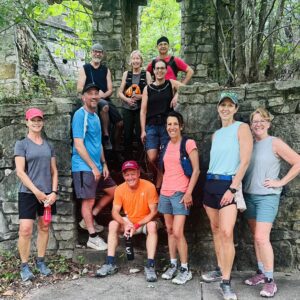
The hike lead typically takes a group photo at the start of a hike. It is a nice souvenir, and it also does real work—it gives the hike lead a headcount that won’t be forgotten, and it means the lead knows what everyone is wearing if they ever need to look for someone.
You do NOT have to be in the group photo if you don’t want to. When you sign the waiver you answer YES or NO to Hike NWA using your image, and that answer is where the decision is made. You can change it at any time by telling a hike lead or writing to [email protected].
If you answered NO, tell your hike lead and stay out of the group photo. If you step into it anyway, you are agreeing that Hike NWA may use that one photograph, and that overrides your answer for that photo only.
Photos may appear in the hike debrief posted to the Facebook group, on hikenwa.org, and in Hike NWA’s own emails and materials.
If you would rather not be photographed, just mention it to the hike lead. A quiet word before the photo is all it takes, and no explanation is needed. Please tell them directly rather than just stepping out of frame because leads often take candid photos along the hike as well. Telling the lead directly that you don’t want to be photographed is what keeps you out of those candid shots.
Sharing the Trail
Most of the trails we hike are shared with mountain bikers, and a collision is possible. To be safest, hike single file on narrow and two-way singletrack, stay together as a group, and learn these calls before your first hike.
Calling Out Cyclists
Whoever sees a bike first calls it out. This is everyone’s job, not just the hike lead’s or the sweep’s.
Call “RIDER UP” for a rider coming toward the group and “RIDER BACK” for a rider coming up from behind. Then pass the call along the line so hikers at both ends hear it. Some riders might ring their bell to make you aware of their presence, but most will not announce themselves. That is usually because they either don’t have a bell or they know they are supposed to yield to hikers, so they are just waiting for a hiker to notice them.
Yield to the Same Side
Bikes are technically supposed to yield to hikers and trail runners, but in practice, it is generally easier and safer for hikers to yield to bikes. When you meet a cyclist, every hiker steps off the trail to the same side—match whoever is ahead of you in line—so the rider has one clear path instead of a gap to thread.
Be cautious about stepping toward a drop-off, ledge, steep bank, or into underbrush. Take the safe side—maybe even move along the trail a little further to get to a spot without the underbrush—and let the rider pass. Step fully off the trail, stand still, and stay off the tread until every rider has passed. Riders will often communicate how many more riders are behind them.
Weather and Cancellations
When inclement weather is in question, the hike lead will typically make the call at least an hour before the scheduled start time. To let the hikers know a hike is cancelled, the hike lead will post the decision as a comment on the Facebook Event, then cancel the event and leave the notice up so everyone can see the reason for the cancellation.
Check the event before you leave home, especially when the weather forecast is unpredictable. Note that leads won’t always cancel for forecasted light rain—a little rain is often welcome when temperatures are high.
A hike may also be cut short or turned around partway if conditions change, such as for thunderstorms or lightning. Please support that decision when the call is made.
Socials
We hold socials throughout the year, often alongside a hike, with everyone bringing food to share at the trailhead. These are posted as Facebook Events like everything else. If you have a food allergy, please ask about ingredients—the dishes are usually homemade and are often not labeled.
Happy Hour Hikes
A Happy Hour hike is a late-afternoon hike, usually around 4 miles at a Raccoon pace (about 3.0 mph). After the hike, participants may go to a nearby restaurant to eat together. Happy Hour hikes are always designated as such in the event listing.
Happy Hour hikes are for hikers age 21 and over.
The hike is the Hike NWA part. What happens afterwards is not—Hike NWA does not organize, host, serve, or pay for the meal, and hikers who go make their own arrangements. What you order is your own decision and your own responsibility, including getting yourself home.
Taking Care of the Trails
Pack out everything you bring, including fruit peels and pistachio shells. Leave rocks, flowers, and artifacts where they are. Follow the rules and closures of whatever park, city, or landowner we are visiting.
Trail Stewardship Days
Hike NWA hosts Trail Stewardship Days, where hikers can learn how to look after the trails they hike—picking up trash, trimming back the growth that crowds the tread, and basic trail maintenance. No experience is needed, and anyone who is interested is encouraged to come.
Got Questions?
Get in touch through the contact page, or ask any hike lead on the trail.
That’s everything.
You’ve read all 15 sections. The last step before your first hike is the waiver.
Sign the waiverHike NWA Community Fundamentals · Version 1.0 · Effective August 22, 2026